

When it’s time to automate your flexible packaging line, one question inevitably surfaces: should you go with a premade pouch packaging machine or a Vertical Form Fill Seal (VFFS) system? Both technologies are widely adopted across food, pharmaceutical, and daily chemical industries, yet they serve fundamentally different operational needs.
Choosing the wrong system can lock you into higher operating costs, slower changeovers, or production bottlenecks that last for years. This guide breaks down how each machine works, where each excels, and—most importantly—how to match the technology to your product volume, packaging format, and long-term business goals. No sales pitch. Just a practical framework for smart capital planning.
Understanding the mechanical difference between the two systems is the first step toward making a confident choice.
(https://youtu.be/Lz7VKxbLEzQ?si=DTtRB2cUrngiahJi)
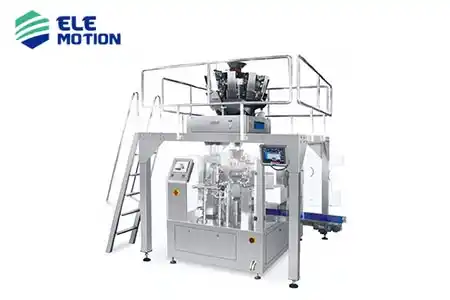
VFFS (Vertical Form Fill Seal) machines start with a flat roll of flexible film. The film is unwound, formed into a tube around a vertical forming collar, sealed along the back seam, filled with product from above, and then cross-sealed and cut into individual pouches—all in a continuous, automated process. The entire bag is created on the machine itself, meaning no pre-made packaging inventory is required, and material handling is streamlined from a single roll.
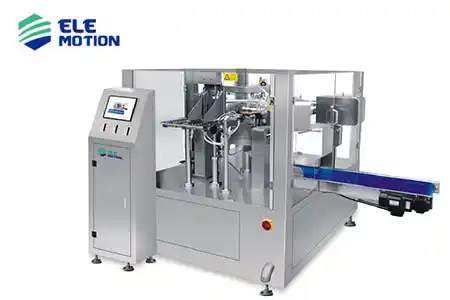
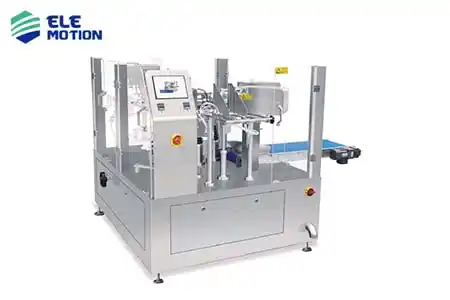
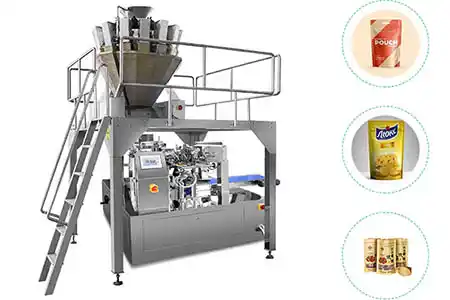
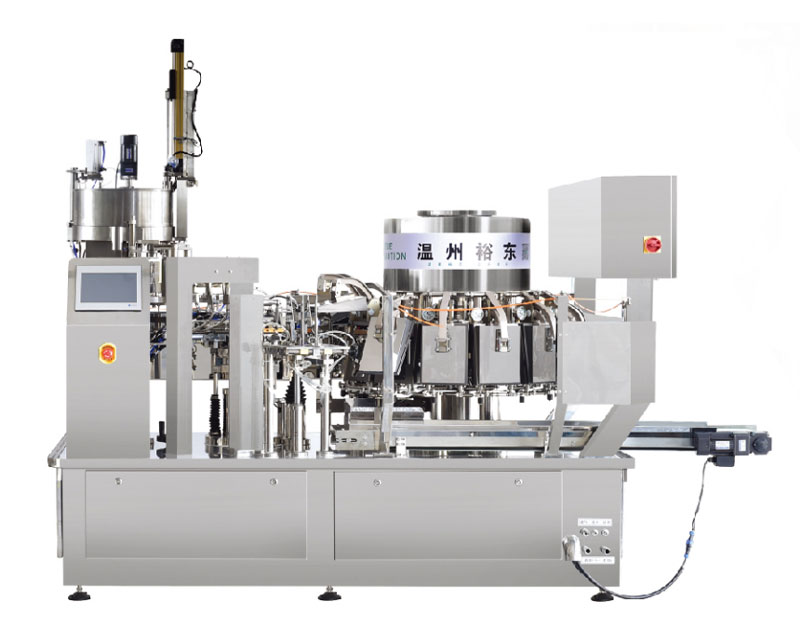
Premade pouch packaging machines take a different approach. The pouches arrive already manufactured—printed, cut, and ready to use. The machine picks each pouch from a magazine (typically using suction cups or mechanical grippers), opens it, fills it with product, and seals the top. Because the pouch is already formed, the machine focuses entirely on filling and sealing operations, not bag creation.
Why this matters to you:VFFS compresses the entire packaging process into a smaller footprint and lower material cost per bag. Premade pouch systems decouple bag formation from filling, giving you access to a much wider range of bag styles without complex on-machine tooling.
Which system wins on speed? On cost? On flexibility? The honest answer is “it depends.” Here’s a structured comparison across the metrics that directly impact your bottom line.
| Decision Factor | VFFS Machine | Premade Pouch Machine |
|---|---|---|
| Packaging speed | 40–200 bags/min | 20–80 bags/min |
| Material cost per bag | Lower — roll‑stock film is 20–40% less expensive than premade pouches | Higher — you pay for pre‑formed pouch manufacturing plus storage |
| Changeover time | Longer — requires adjusting forming collars and seal jaws | Faster — typically 10–30 minutes by swapping pouch magazine |
| Bag style range | Pillow bags, gusseted bags, quad‑seal, stick packs | Stand‑up (Doypack), flat‑bottom, zipper, spout, 8‑side seal pouches |
| Operator skill needed | Higher — film properties, seal temperature tuning, and mechanical adjustments require training | Lower — simpler pick‑and‑fill mechanism, less technical maintenance |
| Floor space | Compact — vertical stack saves valuable factory footprint | Moderate — requires storage for pre‑made pouch inventory |
| Print quality | Direct‑to‑film printing | Pre‑printed at pouch factory — sharp, full‑coverage graphics |
To explore VFFS machine configurations that support high‑speed, high‑volume runs for powders and granules, review how continuous vertical forming systems are designed for free‑flowing dry goods.
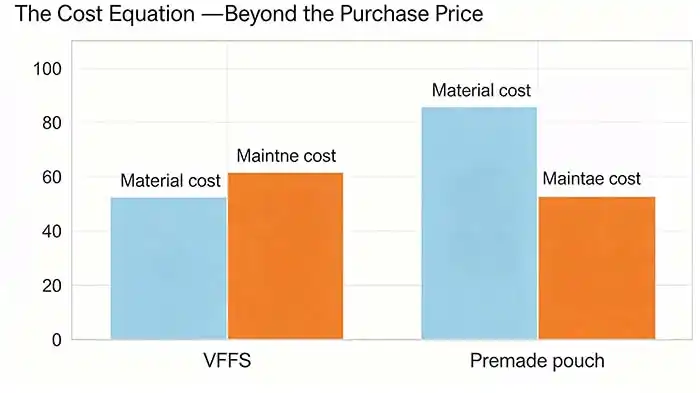
Many buyers focus on the upfront equipment cost, but the operating cost difference between these two technologies often exceeds the initial price gap within the first 12–24 months.
VFFS operating economics: Roll‑stock film is significantly cheaper than pre‑made pouches. For a high‑volume operation producing 500,000+ bags per month, VFFS can reduce material costs by $0.02–$0.08 per package compared to premade pouches. However, VFFS systems have more moving parts—film drives, forming collars, multiple seal bars—leading to higher ongoing maintenance expenses. One industrial coffee producer found that while VFFS saved $50,000 annually in material costs, maintenance ran $30,000 higher per year than an equivalent premade pouch line, significantly narrowing the net savings.
Premade pouch operating economics: The per‑bag material cost is higher, but the machine itself is mechanically simpler. Fewer moving parts means lower maintenance requirements and less frequent specialized service calls. Operator training costs are also lower, as production staff with basic training can handle most routine maintenance tasks.
No amount of cost analysis matters if the machine cannot handle your product reliably. The “product‑first” rule is simple: match the filling mechanism to the physical characteristics of what you are packaging.
Choose VFFS when your product is:
Free‑flowing: Granules, powders, nuts, coffee beans, rice, sugar. Gravity can pull these through the forming tube without clogging.
Dry and non‑sticky: snacks, pet food, hardware. The continuous drop motion works cleanly.
High‑volume and low‑variety: You run the same bag format for hours or days without frequent changeovers.
Caution:Very fine powders can create powder entrapment in the cross‑seal jaws of a VFFS machine, leading to seal failure. Mitigating this requires servo synchronization and dust extraction systems—additional cost and complexity.
Choose premade pouch when your product is:
Fragile or irregular: Cookies, chocolates, frozen dumplings, fresh produce. Product drops directly into an already‑open pouch rather than falling through a forming tube, reducing damage risk.
Viscous or wet: sauces, pastes, liquids, fresh meat. Premade pouches handle thicker materials more reliably than gravity‑fed VFFS systems.
Retail‑ready with premium packaging: stand-up pouches, zipper closures, spouts, or degassing valves for coffee. These features are natively supported.
For product‑specific packaging considerations—including fragile foods, sticky materials, and high‑presentation requirements—see how different material characteristics influence machine selection.
According to PMMI’s 2025 State of the Industry report, “flexibility, efficiency, and user‑friendliness” have emerged as central themes in packaging machinery specification. Customers are increasingly seeking equipment that can handle high SKU counts and innovative formats with minimal downtime.
The U.S. packaging machinery market reached $11.3 billion in sales in 2024, and while near‑term growth is projected at a modest 2.2% for 2025, the long‑term trend reflects steady investment in automation, particularly in sectors navigating workforce shortages and demand for more versatile machinery.
Many factories actually run both technologies. One nut exporter started with VFFS for 25kg bulk bags, then added a premade pouch machine for retail line expansion—because roll film makes sense for bulk, but retail shelves demand premium package aesthetics.
Consider a phased approach:
Launch phase: Premade pouch machine for retail‑ready, high‑impact packaging on small to medium volumes.
Scale phase: Add VFFS for high‑volume commodity lines where material cost per bag is the dominant metric.
Mature phase: Run both—premade pouch for premium SKUs, VFFS for bulk/economy lines.
Once you have clarified your key decision factors—production volume, product characteristics, target bag styles, and facility constraints—comparing the specific specifications of available options becomes the next logical step. You can explore volumetric filling systems designed for granular and powder products, review oxygen‑barrier packaging solutions for extended shelf life, or examine continuous bagging platforms optimized for dry free‑flowing goods.
How to Calculate Packaging Line ROI for Small to Mid‑Sized Manufacturers
Flexible Packaging Material Compatibility: Film vs. Premade Pouch Selection Guide
Automated Changeover Strategies for High‑SKU Production Environments
Powder Packaging Best Practices: Preventing Seal Contamination
Sustainability in Flexible Packaging: Mono‑Material Films and Recyclable Pouches
This article is part of Wenzhou ELEMOTION Automation Technology Co., Ltd.’s technical content library. No direct sales or pricing information is included. All technical discussions aim to help you make informed purchasing decisions.

GET A QUOTE