

Vertical packing machine sealing errors almost always trace back to four variables: heat, pressure, dwell time, or mechanical alignment. When a bag leaks from the top seal or bursts at the side seam, the culprit isn‘t mysterious. Go straight to your sealing jaw temperature first. 85% of the weak seals I’ve diagnosed over the years were a matter of the jaw running 10–15°C colder than the film actually requires. Grab an infrared thermometer. Measure at five points across the jaw face. If you see a spread of more than ±3°C, you have a temperature uniformity problem, and no amount of pressure adjustment will compensate for it. Once the thermal baseline is solid, then you can work through alignment, dwell timing, and material compatibility. Below, I’ll unpack each failure mode the way I would standing next to a machine on a factory floor.
Years back, I was called to a snack manufacturing facility. They’d spent three shifts replacing sealing jaws, swapping out thermocouples, and dialing pressure up and down on a vertical bagging machine seal failure they couldn’t solve. The actual problem? A worn linear bearing in the jaw carriage. The jaws were tilting about 0.8 mm on every close cycle. Carbon paper impressions showed the right edge of the seal hardly making contact. No electrical fix was going to help.
This is the pattern I see constantly. People reach for the temperature controller before checking whether the mechanical foundation is sound. Here’s a smarter sequence: alignment first, thermal second, film third. Get that order right and most troubleshooting hours essentially disappear.
Every heat seal on a VFFS machine sealing problem boils down to the same physics as any thermal bond: temperature × pressure × dwell time. Tweak one without compensating the others and the seal fails.
Most laminated films used in vertical filling sealing machine heat seal troubleshooting seal within 120–200°C, but the exact window depends on the sealant layer. LDPE starts sealing around 110–115°C, PET/AL/PE laminates demand 160–200°C, and CPP typically needs 110–150°C. That‘s a narrow margin. When I audit a line, the first thing I measure is whether the jaw face temperature matches the controller readout. A 15°C discrepancy between the thermocouple location and the jaw surface is common because thermal resistance builds up across the gap. An infrared pyrometer reading directly at multiple jaw-face points tells the real story.
The faster the machine cycles, the less time heat has to migrate through film layers into the sealant. In high-humidity environments, film absorbs moisture that flashes to steam during sealing, creating micro-channels that become leak paths. I’ve seen lines pushing 80 bags per minute where the actual dwell time on the cross-seal jaw was under 0.15 seconds—well below what the film specification called for. Slowing the cycle by half a second and increasing pressure slightly restored seal integrity without any temperature change.
Carbon paper impressions across the sealing jaw face will tell you within 30 seconds whether you have a pressure distribution problem. Worn spring tension on cross-sealing jaws, debris caught between the jaw and the mounting surface, or uneven pneumatic cylinder actuation all produce weak spots. Inconsistent seal bead width—thick on one side of the pouch, paper-thin on the other—means jaw parallelism is off.
Table 1: Common Heat-Seal Defect Types & Quick Diagnosis
| Symptom | Likely Cause | First Check |
|---|---|---|
| Seal peels open with light finger pressure | Temperature too low / dwell too short | IR thermometer across jaw face |
| Scorched or melted film at seal edge | Temperature too high / dwell too long | Controller setpoint vs. actual; check for overshoot |
| Seal wrinkles or puckering | Jaw temperature excessive; film shrinkage | Reduce temp by 5°C increments; test film type |
| Seal bead inconsistent in width | Jaw misalignment or uneven spring pressure | Carbon paper test; inspect jaw bearings |
| Contaminant specks embedded in seal area | Product dust drawn by static; fill timing off | Check static ionizer bars; adjust drop timing |
The forming tube, longitudinal sealing bar, and cross-seal roller centerlines must lie in a single plane . A lateral offset of just 1–2 mm in the forming tube relative to the collar produces diagonal wrinkles that turn into seal weaknesses downstream. I require maintenance crews to verify forming tube verticality with a machinist’s level every quarter. Even a 2° tilt creates persistent creasing that operators waste hours chasing through temperature adjustments.
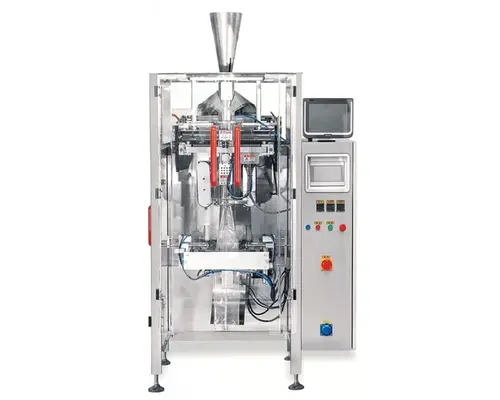
The difference between a machine that seals reliably for 10 million cycles and one that drifts out of spec within six months often comes down to how the manufacturer manages jaw alignment. Premium machines running servo-driven sealing jaw control maintain positioning accuracy within ±0.5 mm using closed-loop feedback. Mid-range equipment typically straddles ±1.0–1.5 mm with mechanical cam adjustment. Older systems relying on pneumatic actuation with limit switches routinely drift past ±2.0 mm between maintenance intervals. In a vertical bagger cross-seal defect scenario, that 1.5 mm gap is the difference between a hermetic seal and a product recall.
Reciprocating jaw carriages cycle millions of times. Linear bearings wear, resulting in play that allows the jaw to shift during closure. A carbon impression from a vertical bagger jaw revealed that what looked like a temperature problem was actually a worn set of linear bearings—replacing them restored seal uniformity immediately. I cannot stress this enough: inspect jaw carriage bearings before touching the temperature controller.Paragraph
Packaging film static charge attraction is one of those problems that masquerades as a temperature fault. Film unwinding from a roll at speed generates substantial static charges. These charges pull fine powder, seasoning dust, or granule fragments onto the inner film surface precisely where the cross-seal will form. The contaminant sits between the sealant layers, preventing fusion. The fix isn’t electrical—it‘s positioning static neutralization bars just before the forming tube and again immediately upstream of the sealing station.
Telescoped rolls, inconsistent web thickness, and residual curl from poor storage all cause VFFS film tracking misalignment that shifts vertical seal position. When the long seal drifts off-center, the cross-seal encounters variable material thickness at the gusset folds, creating pressure imbalances. I’ve seen procurement teams save 8% on film cost and then lose 15% in increased scrap and downtime. Specify width tolerance at ±0.5 mm and gauge variation under 3% to your film supplier. If they can‘t meet that, you’re buying problems, not savings.
Different film structures require fundamentally different thermal profiles. PE films typically seal at 160–180°C, while PP demands 180–200°C and PET-based laminates require 180–220°C. When a production line switches between LDPE and metalized PET/PE pouches mid-shift without altering parameters, burned seals or leaky seams are guaranteed outcomes. Document film-specific sealing recipes—temperature, dwell time, and pressure—and store them as digital seal parameter profiles in the machine‘s HMI for rapid changeover.
Table 2: Recommended Seal Parameter Ranges by Film Type
| Film Structure | Seal Temp Range (°C) | Typical Dwell (sec) | Notes |
|---|---|---|---|
| LDPE (mono) | 120–150 | 0.8–1.5 | Low-temperature film; easy to scorch if dwell too long |
| CPP-based laminates | 110–150 | 1.0–2.0 | Slightly higher temp than LDPE; good hot-tack |
| PET/AL/PE laminates | 160–200 | 1.0–2.0 | Heat travels through foil layer; temp uniformity critical |
| PP-based laminates | 180–200 | 1.0–2.5 | Higher melt point; verify heating element capacity |
Ambient factory conditions don‘t get nearly enough attention. On a UAE production floor at 42°C, the thermal gradient between the sealing jaw and surrounding air collapses. Residual heat from the previous cycle doesn’t dissipate, so the jaw closes on film with more energy than the controller setpoint indicates. For thin PE laminates and compostable PLA structures, that overshoot means burn-through or delamination. Active jaw cooling—closed-loop water or Peltier systems—isn‘t optional in high-ambient environments; it’s the difference between running and scrapping.
On the flip side, cold factory floors in northern climates at 8–10°C draw heat from the jaw faster than the PID loop can compensate during startup, producing intermittent cold seals for the first 20–30 minutes until the jaw body reaches thermal equilibrium. Pre-warming the jaws before production start is a simple countermeasure that too few shift supervisors mandate.
If you‘re spending more than two hours a week on vertical packing machine sealing errors, the problem isn’t your maintenance crew—it‘s your machine architecture. Older pneumatic systems rely on mechanical cams and limit switches that drift with wear, temperature, and compressed air fluctuations. There’s a ceiling to what you can calibrate.
Modern servo-driven vertical packaging machines control jaw position, velocity, and pressure independently via programmable motion profiles. This means the jaw can decelerate gently before contact, apply a precise dwell pressure for an exact number of milliseconds, and release cleanly. A servo system holding seal jaw temperature uniformity within ±1°C across the full jaw width delivers the kind of consistency that pneumatic systems with ±5°C fluctuations simply can‘t approach. One plant I consulted for switched from a pneumatic VFFS to a servo-controlled continuous motion bagging system and cut seal-related reject rates from 3.2% to 0.4% in under a month—mostly by eliminating dwell-time variability during speed changes.
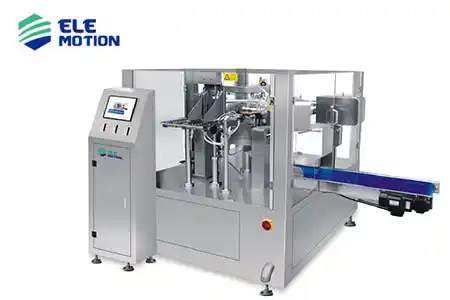
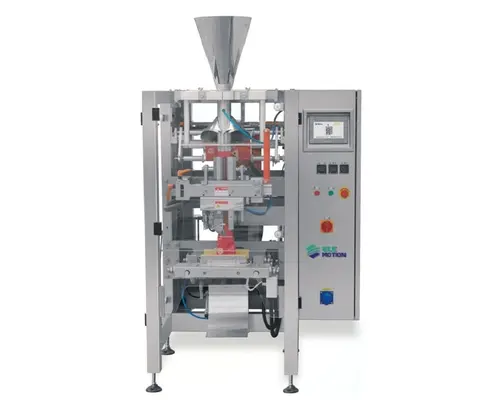
The ELEMOTION vertical packing machine addresses these challenges from the design stage. Its dual dancing-arm system with closed-loop film tension control maintains film tracking within 1.2 mm, delivering a measurable 92% reduction in film waste. The servo-driven sealing jaws incorporate precision-ground serration patterns that distribute pressure evenly across the full seal width, eliminating the cold spots that plague lesser machines. Temperature controllers with ±1°C accuracy and real-time PID compensation respond to line-speed changes without overshoot or droop. And in a practical touch for maintenance crews, the jaws release via spring-loaded levers—no wrenches needed for cleaning or changeover.
What separates a high-speed servo pouch packaging solution from commodity equipment isn’t any single component—it‘s the integration. When the film tracking system, temperature controller, jaw drive, and product filling synchronize on a common motion bus, variables that operators previously adjusted by gut feel become repeatable, digitally stored recipes.
For pharmaceutical and food-grade operations requiring documented validation, ELEMOTION provides full IQ/OQ/PQ packaging machine validation documentation. Having installation qualification, operational qualification, and performance qualification protocols delivered with the machine dramatically shortens the timeline from equipment arrival to production release.
Even the best-engineered machine eventually needs maintenance. ELEMOTION supports customers with fast-turnaround spare parts supply and remote diagnostic services. Our service team can often identify sealing jaw misalignment adjustment needs or temperature calibration issues through live video consultation, getting your line running before a technician would even reach the airport.
| Feature | Legacy Pneumatic VFFS | Servo-Driven System |
|---|---|---|
| Jaw position accuracy | ±2.0 mm (mechanical stop) | ±0.5 mm (closed-loop encoder) |
| Temperature uniformity across jaw | ±5°C typical | ±1°C (precision PID + uniform heating elements) |
| Dwell time consistency at speed change | Variable (pneumatic lag) | Programmable, millisecond-precise |
| Film tracking precision | ±3–5 mm drift between adjustments | ±1.2 mm (closed-loop tension control) |
| Changeover between film types | Manual parameter entry; trial-and-error | Stored digital recipes; instant recall |
Seal errors are never random. They’re always the result of a measurable variable drifting outside its process window. The systematic approach I’ve outlined—alignment first, thermal second, film third, environment always in mind—will solve 90% of vertical packing machine sealing errors before you ever need to call a technician.
If you‘re running a machine where the same seal faults keep returning no matter how carefully you calibrate, it may be time to evaluate whether the equipment itself is holding you back. The ELEMOTION vertical packing machine was engineered specifically to eliminate the root causes of seal failure: unstable temperature control, mechanical drift, film tension variability, and contamination ingress.
Ready to diagnose your sealing problem or explore a longer-term fix? Explore the ELEMOTION vertical packing machine series and request a sample-run video demonstrating seal quality at your target speed. Our application engineers will analyze your current film specification, product characteristics, and output targets to recommend a configuration that delivers consistent, hermetic seals shift after shift.

GET A QUOTE