

You’ve probably been staring at spec sheets for the past week. They all talk about forming areas, clamping forces, and cycle times. But what you’re really trying to figure out is much simpler: “Will this machine actually pay for itself, or will it bleed my factory dry with scrap and energy costs?”
The short answer—a modern plastic thermoforming machine built with servo-driven precision and smart energy management won’t just pay for itself; it will quietly reshape your entire profit structure in ways older hydraulic equipment never could. In fact, independent analyses show that upgrading to an advanced thermoforming equipment system with regenerative heating and AI-powered parameter setting can slash energy use by 25% to 30% compared to conventional models, while patented closed-loop regrind systems reintroduce up to 98% of in-process scrap back into production without compromising quality. Let me walk you through exactly what separates a money-maker from a money-pit, drawing from real shop-floor experience and industry benchmarks you won’t find in glossy brochures.
The first reality check: not all plastics behave the same, and a machine that screams through PET might choke on recycled PP.
Most small to medium-sized packaging operations fall into the thin-gauge category (sheet thickness typically 0.2 mm to 1.5 mm), cranking out disposable cups, food containers, blister packs, and clamshells. This is high-speed, high-volume territory. If you’re running a roll-fed line, you’re looking at cycle rates of 30 to 50 cycles per minute depending on the material and part depth.
Heavy-gauge thermoforming (3 mm to 12 mm or more) is a different beast entirely—think refrigerator liners, automotive interior panels, and industrial equipment housings. These machines are sheet-fed (not roll-fed) and demand significantly higher heating and forming forces. For most packaging-centric businesses reading this, we’ll focus on thin-gauge systems, because that’s where the day-in, day-out ROI fight really happens.
Here’s where many buyers get burned. They buy a machine that technically “supports” a list of resins, but the actual forming quality varies wildly. A professional-grade plastic thermoforming machine should give you predictable, repeatable results across PVC, PET, PS, PP, PLA, and even post-consumer recycled content. And here’s the gritty detail: modern machines with advanced electrostatic web stabilization can now run sheets with 30% PCR content at 40 m/min without wrinkling—something unheard of just five years ago. That matters, because more clients are demanding sustainable packaging, and you don’t want to tell them “sorry, my machine can’t handle it.”
I’ve seen shops buy the cheapest machine that could form PP, only to discover that every material change required four hours of recalibration and a pile of rejected parts. A well-engineered thermoforming equipment system with precise ±1°C zonal temperature control (like what ELEMOTION integrates across its four-stage electric heating furnaces) eliminates that guesswork. You set the profile once, save it to the PLC, and recall it with a single button press.
Let’s talk money in a way that procurement departments rarely admit: upfront cost is a liar. I’ve watched a shop celebrate their “bargain” purchase for two weeks, then spend the next six months bleeding cash on overtime, unplanned downtime, and rejected pallets of food containers.
According to ROI modeling data, well-run thermoforming operations with modern servo-driven systems typically see payback periods of 11 to 18 months, with internal rates of return ranging from 15% to 25% depending on scale. Here’s what drives those numbers:
Energy consumption — Older hydraulic or Calrod-based machines are energy hogs. Infrared heating systems have been shown to deliver 40% energy savings compared to conventional Calrod heaters, with some ceramic systems achieving 45%+ reduction in measured tests. ELEMOTION’s closed-loop digital temperature control hits ±1°C accuracy while cutting approximately 15% off your heating bill and extending furnace plate life significantly.
Labor reduction — A full-automatic multi-station line can save up to one-third of manpower compared to semi-automatic setups. That’s real money, especially in markets where skilled operators command premium wages.
Scrap reduction — If your scrap rate is above 3% to 5%, you’re leaving money on the floor. Industrial waste can eat up 15% to 20% of raw material costs on poorly calibrated machines. Good machines with closed-loop regrind systems automatically reclaim 98% of in-process trim scrap.
Throughput per hour — Newer generations of high-performance thermoformers are achieving cycle speed increases in the double digits (some reports cite 30%+ improvements) while simultaneously improving product quality and lowering energy use.
Downtime minimization — Every hour your line is down for unscheduled repairs costs you not just the repair bill, but lost production, delayed customer orders, and stressed-out operators. Preventive maintenance—regular cleaning, lubrication, filter changes, and heater inspections—can extend machine life to decades. ELEMOTION supports this with a comprehensive one-year free maintenance policy and long-term technical training for your crew.
Let me be blunt. Shipping, installation, and training typically add 10% to 20% to the base price. Many buyers forget to budget for mold costs—simple molds start around 10,000,whilecomplexaluminumtoolingcanrun10,000,whilecomplexaluminumtoolingcanrun100,000+. And if you’re sourcing internationally, factor in electrical compatibility (CE, IEC standards) and spare parts availability.
A trustworthy supplier will be transparent about these add-ons upfront. If they’re not, walk away.
Here’s where the industry has quietly transformed over the last five years. Older thermoforming machines relied heavily on hydraulics and pneumatic systems. They worked, but they were noisy, power-hungry, and prone to drift as components wore.
Today’s best-in-class thermoforming equipment leans hard into full-servo motor architecture for all motion sequencing—feeding, forming, plug assist, trimming, stacking. Why does that matter to your bottom line? Servo drives offer three killer advantages:
Precision — High positioning and repetition accuracy allow overlapping of working steps, shaving seconds off each cycle.
Energy efficiency — Servo systems consume power only when moving, not continuously like hydraulic pumps.
Consistency — No thermal drift, no pressure fluctuations as oil temperatures change. Every part is identical to the last one.
The days of manually logging cycle counts and guessing when to schedule maintenance are over. Modern plastic thermoforming machine platforms are now equipped with sensors and IoT connectivity that feed real-time data on temperature, pressure, and speed directly to your ERP system (via standard OPC-UA interfaces).
What does that mean for you? Predictive maintenance alerts before a heater fails mid-run. Dashboard visibility into energy consumption per thousand parts. Historical traceability for quality audits. ELEMOTION integrates these capabilities into a user-friendly HMI with remote connectivity, so your team can monitor production even from home—or from a beach, though I won’t tell your boss.
I’ve walked onto production floors where the operator’s “maintenance schedule” was essentially “we’ll fix it when it breaks.” That strategy works great—until it doesn’t. And then it works terribly for about three weeks while you scramble for parts and lose customers.
Based on decades of field data, here’s what keeps a thermoforming machine humming for 15+ years:
Daily: Visual inspection for cracks, loose bolts, worn hoses. Clean plastic dust off the forming area. Check belt tension.
Weekly: Lubricate chains, rollers, and guide rails. Test safety switches and thermocouples.
Monthly: Inspect vacuum pumps for leaks or unusual noise. Change air filters. Calibrate zone temperatures (target ±2°C or better).
Quarterly: Inspect and replace bearings as needed. Change coolants and oils. Verify heater elements for discoloration or uneven radiation.
A maintenance regime can reduce unplanned downtime to near-zero. ELEMOTION provides detailed OEM maintenance guidelines and spare parts support to keep your line running without those 3 a.m. panic calls.
Heater failure and thermal runaway are the two most common crises in thermoforming. If a heating zone drops temperature, you’ll see inconsistent forming, thinning in deep-draw areas, and rejected parts stacking up. The fix is simple: check the heater element, replace if damaged, and recalibrate the zone controller.
Material feed problems—jams, misalignment, uneven pull—usually trace back to worn feed rollers or incorrect tension. ELEMOTION machines use servo feeding with stepless adjustment of sheet length, minimizing these headaches. But still, check those rollers weekly.
Malformed products? Nine times out of ten, it’s either inconsistent material thickness, mold temperature out of spec, or inadequate forming pressure. Run through those three checks before you call a technician.
Here’s a truth most catalogs won’t tell you: the perfect off-the-shelf machine doesn’t exist. Your floor space, your material mix, your operator skill level, your downstream packaging line—these variables are unique to your facility. A supplier that only offers “stock models” is forcing you to compromise.
A small start-up factory making 250,000 units a year has completely different needs than a regional packaging producer running 3 million units. Small shops benefit from compact, economical automatic machines that save rental space and reduce early fixed-cost pressure. Medium producers need flexible multi-station systems that can switch from food trays to medical blister packs in under two hours.
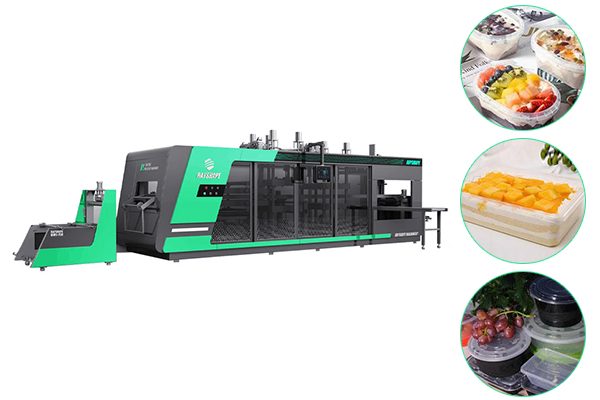
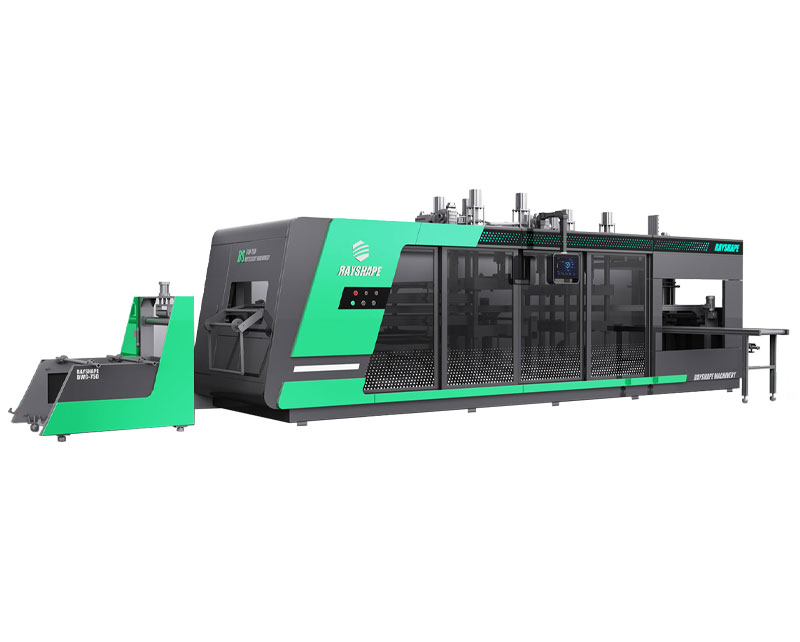
Large-scale operations demand full-automatic roll-fed lines with robotic stacking, inline punching, and real-time quality monitoring. ELEMOTION addresses this spectrum with models ranging from three-station to four-station configurations, covering forming areas like 650×450 mm and 730×610 mm, and delivering packaging speeds up to 45 molds per minute.
Customization can mean many things. For some, it’s an extended heating tunnel for thicker sheets. For others, it’s a specialty plug-assist for deep-draw cups. Or a particular stacking orientation that feeds directly into your existing conveyors.
The key is finding a partner that doesn’t treat every request as a six-month R&D project. ELEMOTION holds a 30-person after-sales and engineering team that handles custom requests efficiently, backed by over 20 years of packaging automation experience within the Elemotion Group. That means shorter lead times and fewer surprises when the machine arrives at your dock.
Now, for the comparison that every sourcing manager eventually wrestles with: thermoforming vs. injection molding. Because if you’re making plastic parts, injection molding always looks tempting on a per-part basis. But that high-volume gloss hides some brutal upfront realities.
| Factor | Thermoforming | Injection Molding |
|---|---|---|
| Tooling Cost | Low (aluminum molds, weeks to produce) | High (steel molds, months to produce) |
| Time to Market | 6–8 weeks for production tooling | 12–20 weeks for production tooling |
| Part Finish | High-quality right out of mold; easily painted | Typically requires painting |
| Prototyping Cost | Low; simple sheet-based | High; complex mold required |
| Material Form | Plastic sheets, flexible and malleable | Pellets, melted and injected |
| Part Thickness Variation | Relatively uniform wall | Can vary thickness within part |
Data from engineering and plastics industry sources confirm that thermoforming offers significantly faster turnaround (“weeks instead of months for time to market”), lower tooling costs (single-sided aluminum mold vs. double-sided steel), and excellent out-of-mold finish that often doesn’t need painting.
Where injection molding wins is in small, intricate parts—bottle caps, tiny fasteners, complex geometries with undercuts—and in extremely high-volume runs where the high tooling cost gets amortized over millions of parts. But for packaging, trays, protective enclosures, automotive interior panels, and display items? Thermoforming is often the smarter, faster, cheaper path.
Traditional vacuum forming works fine for simple shapes, but if you need sharp details, tight tolerances, or undercuts, you want pressure forming capability. Positive pressure (typically up to 50 psi or more) applied from above the sheet simultaneously with vacuum from below dramatically increases forming force, delivering detail quality that rivals injection molding but with thermoforming’s cheaper tooling.
ELEMOTION’s multi-station plastic thermoforming machine incorporates precisely this positive-and-negative pressure forming technology, using internationally advanced sheet-forming methods to produce parts that look and feel premium—without paying injection molding’s tooling bill. For businesses walking the line between cost and quality, this is not a minor feature. It’s a competitive advantage.
Not every operation needs to upgrade. But if you recognize any of the patterns below, the math probably works in your favor.
Your scrap rate has crept above 5% and no amount of operator retraining seems to fix it. You need a machine with better material handling, more stable heating, and inline regrind.
Energy bills keep climbing while production volume stays flat. An old Calrod-based system could be silently burning 30–40% more electricity than a modern servo-driven or infrared system.
Changeovers feel like punishment. If switching from producing food trays to medical blisters takes your team more than 2–3 hours, you’re losing flexible capacity.
Customers are asking for sustainable materials (PCR content, PLA, biodegradable films) and your current machine struggles to form them consistently. The market is shifting, and your equipment needs to shift with it.
ELEMOTION machines are engineered with multi-material compatibility, PLC-based recipe storage (so changeovers take minutes, not hours), closed-loop temperature control for ±1°C accuracy, and built-in edge-winding and scrap-regrind systems that support both virgin and recycled materials. They’re not just machines. They’re insurance policies against falling behind.
You’ve read the benchmarks. You understand the ROI math. You’ve seen how automation, servo precision, and multi-station flexibility separate profit centers from cost centers. Now it’s time to see how ELEMOTION puts these pieces together in a machine that fits your floor, your budget, and your growth plans.
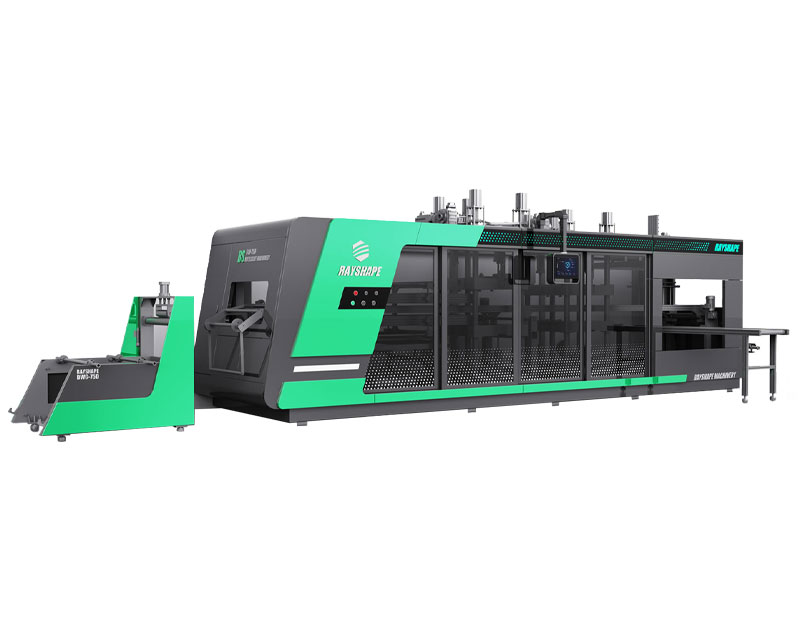
Our plastic thermoforming machine line includes three-station and four-station configurations, forming areas covering 650×450 mm and 730×610 mm, and packaging speeds up to 45 molds per minute. Every unit is built on a mechanical-pneumatic-electrical integrated architecture, controlled by microcomputer/PLC with remote connectivity, and backed by comprehensive training and a one-year free maintenance warranty.

GET A QUOTE